The Inbox Is Still the Most Dangerous Place in your business
Email has been around for decades. It has survived the rise of instant messaging, social platforms, and video calls. Businesses still depend on it for contracts, invoices, customer communication, and internal coordination. And that is exactly why cybercriminals still depend on it too.
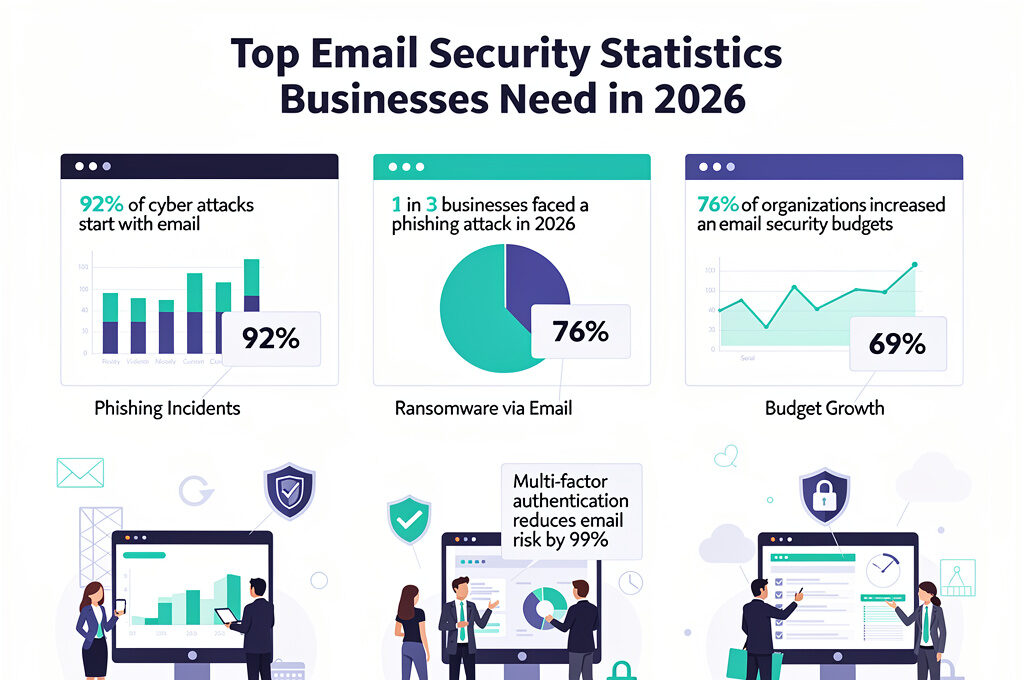
In 2026, email-based attacks are not declining — they are becoming more targeted, more convincing, and more expensive to recover from. The statistics in this article tell the story clearly. More importantly, they point to specific actions every business can take to protect itself.
Whether you run a five-person operation or a five-hundred-person organization, these numbers apply to you.
The Staggering Scale of Email Threats
Before looking at specific attack types, it helps to understand just how large the threat landscape has become.
- Over 3.4 billion phishing emails are sent globally every single day
- Email is the initial delivery vector in 91 percent of all cyberattacks
- 94 percent of malware reaches its target through email
- Business email fraud losses surpassed 2.7 billion dollars in 2025, according to FBI crime reports—and 2026 figures are projected to be higher
These are not edge cases or theoretical risks. They are the daily operational reality for businesses connected to the internet.
Phishing: More Sophisticated Than Ever
Phishing attacks have evolved far beyond the obvious scam emails of the early internet. In 2026, the most dangerous phishing attempts are nearly indistinguishable from legitimate communication because they use real information about the target.
Spear-phishing, a highly personalized form of the attack, now accounts for 65 percent of all phishing attempts.
- Spear-phishing emails achieve click-through rates of up to 30 percent
- C-suite executives are targeted three times more often than general staff
- 62 percent of businesses experienced a successful phishing attack in 2025
- AI-generated phishing emails now mimic writing style, tone, and context with alarming accuracy
What Has Changed: Attackers now scrape LinkedIn profiles, company websites, and social media to craft emails that reference real colleagues, real projects, and real timelines. Generic suspicion is no longer enough—staff need specific, current training.
Business Email Compromise Is Costing Millions
Business Email Compromise—or BEC—is one of the most financially damaging attack types facing businesses today. Unlike malware-based attacks, BEC does not rely on exploiting software vulnerabilities. It exploits human trust.
Attackers impersonate a CEO, a vendor, a legal firm, or a financial institution and instruct an employee to transfer funds or share sensitive credentials. The losses can be catastrophic.
- BEC attacks increased by 81 percent year-over-year from 2024 to 2025
- The average wire transfer requested in a BEC attack: 62,000 dollars
- Finance departments and HR teams are the most frequently targeted
- More than 70 percent of organizations reported at least one BEC attempt in 2025
Unlike traditional fraud, BEC attacks often bypass technical security tools entirely because they contain no malware, no suspicious links, and no attachments. They are purely social engineering, which is why human awareness training is as important as technical defenses.
Ransomware Delivered by Email Is Still Climbing
Ransomware attacks capture headlines when they hit hospitals, municipalities, and large corporations—but small- and mid-sized businesses are targeted just as frequently and often lack the resources to recover quickly.
- 45 percent of ransomware is delivered via email attachments or embedded links
- The average ransomware payment in 2025 reached 1.54 million dollars
- Small and mid-sized businesses are the target in 46 percent of all ransomware incidents
- Average operational downtime following a ransomware attack: 21 days
The Hidden Cost: The ransom payment itself is only part of the damage. Businesses also absorb lost revenue during downtime, IT recovery costs, regulatory fines if customer data was exposed, and lasting reputational harm.
Human Error Remains the Largest Vulnerability
Technology can filter spam, scan attachments, and flag suspicious links. But no technical control eliminates human judgment from the equation—and human judgment makes mistakes.
- 85 percent of data breaches involve a human error component
- Less than half of employees can correctly identify a phishing email when tested
- Regular security awareness training reduces phishing click rates by up to 70 percent
- 52 percent of employees admit to using personal email for work-related communication
The implication is clear: your technical defenses need to be matched by an equally strong investment in people. Policies, training, and a culture of security awareness are not optional extras — they are foundational.
Email Authentication Adoption Is Growing — But Still Incomplete
SPF, DKIM, and DMARC are authentication protocols that make it dramatically harder for attackers to spoof your domain and impersonate your business in phishing campaigns. Their effectiveness is proven. Their adoption, however, is still uneven.
- Only 51 percent of global domains have DMARC records configured
- Domains with DMARC enforcement in place see 80 percent fewer spoofing incidents
- Google and Yahoo now require DMARC configuration for bulk email senders
- 38 percent of organizations that have adopted DMARC have it misconfigured—reducing its effectiveness
If your business domain does not have SPF, DKIM, and DMARC properly set up, you are leaving an open door for attackers to send emails that appear to come from your own company.
What Every Business Should Do Right Now
The statistics above point directly to a practical action plan. These are not theoretical recommendations — they are the baseline defenses that separate prepared businesses from vulnerable ones.
- Configure SPF, DKIM, and DMARC for every email domain your business uses
- Use a business-grade email hosting provider with built-in anti-spam and malware filtering
- Run phishing simulation tests and security awareness training at least quarterly
- Enable multi-factor authentication on all email accounts
- Establish a clear verification protocol for any financial requests received by email
- Encrypt sensitive email communications and restrict access to sensitive inboxes
- Monitor email logs for unusual login patterns or forwarding rules
Your Next Step Forward
Email security is not a one-time setup task. It is an ongoing discipline that requires the right hosting infrastructure, the right tools, and the right habits across your entire organization. The businesses that take it seriously spend less time recovering from incidents and more time focusing on growth.
Site2Host’s business email hosting is built with security at its core. Every plan includes advanced spam filtering, virus scanning, DMARC support, and encrypted storage — providing the technical foundation your business needs to communicate with confidence.