

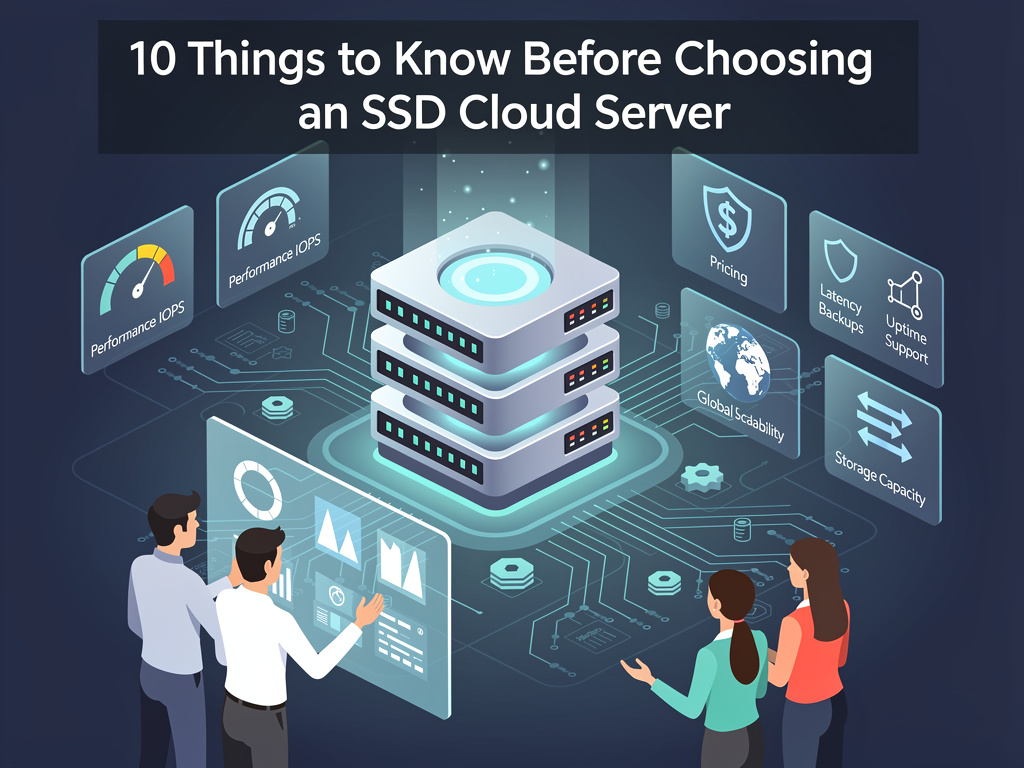
10 Things to Know Before Choosing an SSD Cloud Server
If you have been researching hosting options, you have almost certainly come across the term “SSD cloud server.” It sounds technical, but the business case for it is straightforward: SSD-powered cloud servers are significantly faster, more reliable, and more scalable than their traditional counterparts.
But here is the thing that most hosting guides leave out. Not every SSD cloud server is built the same way, priced the same way, or managed the same way. Making the wrong choice can mean paying more than you need to, dealing with unexpected downtime, or struggling with a provider whose support disappears the moment you have a real problem.
Before you sign up for anything, here are ten things you genuinely need to understand about SSD cloud servers.
1. Understand What SSD Actually Changes About Performance
Traditional hard drives use spinning magnetic disks to read and write data. SSDs — solid-state drives — use flash memory with no moving parts. The result is dramatically faster read and write speeds, which directly translates to faster page loads, quicker database queries, and snappier application performance.
For websites with heavy traffic, e-commerce stores processing real-time transactions, or applications that need to retrieve data quickly, SSD storage is not a nice-to-have. It is the baseline for competitive performance.
2. NVMe SSD Is a Step Above Standard SSD
You will sometimes see providers offering NVMe SSD instead of standard SSD. NVMe — Non-Volatile Memory Express — is a newer interface protocol that allows SSDs to communicate with the server at much higher speeds than the older SATA interface that standard SSDs use.
The practical difference is significant: NVMe drives can be several times faster than regular SSDs in real-world workloads. If a provider offers NVMe, it is worth paying attention to, especially for data-intensive applications.
3. Cloud Is Not the Same as VPS
Many businesses confuse cloud servers with VPS (virtual private servers). They are related but different. A VPS carves out a dedicated portion of a single physical server’s resources for your use. A cloud server draws from a distributed pool of servers, which gives you greater flexibility, redundancy, and scalability.
With a cloud server, if one physical server in the network has a problem, your workload shifts to another automatically. With a standard VPS, your website could go down if the underlying server has an issue.
4. RAM and CPU Matter as Much as Storage
A common mistake when choosing a server plan is focusing only on storage size and ignoring RAM and CPU allocation. Storage holds your files, but RAM and CPU determine how quickly your server can process requests and serve content to visitors.
A resource-heavy WordPress site, a busy WooCommerce store, or any application running background processes will need adequate RAM to avoid performance bottlenecks. Always check all three specs — storage, RAM, and CPU — before selecting a plan.
5. Uptime Guarantees Must Be in Writing
Every hosting provider claims exceptional uptime. What matters is whether that uptime is contractually guaranteed in a Service Level Agreement (SLA). A 99.9% uptime guarantee, for instance, means no more than roughly 8.7 hours of downtime per year.
Before choosing a provider, ask where the SLA is documented and what compensation you receive if they fall short. Providers who are confident in their infrastructure have no problem putting this in writing.
6. Know Where Your Data Actually Lives
Data residency is increasingly important, particularly if your business handles sensitive customer data or operates under regulations like GDPR or India’s data protection laws. Ask your provider where their data centers are physically located and whether you can choose a specific region.
Hosting your data closer to your customers also reduces latency — the time it takes for data to travel between the server and the user. A server based in India will typically load faster for Indian users than one hosted in Europe or the United States.
7. Backup Frequency and Recovery Time Matter Enormously
Automated backups sound reassuring, but the details matter. How often are backups taken—hourly, daily, or weekly? How long are they retained? And most importantly, how long does it take to restore from a backup if something goes wrong?
Some providers offer backups as an add-on at extra cost. Others include it as standard. Either way, understand exactly what you are getting before a crisis happens rather than after.
8. Security Features Should Come Standard, Not As Extras
A quality SSD cloud server provider should include security fundamentals as part of the base service: firewall protection, DDoS mitigation, SSL certificate support, and regular security patches. If a provider is charging extra for basic security features, that is a red flag.
Also check whether the provider conducts regular security audits and how they handle vulnerability disclosures. Security is not a feature. It is a responsibility that your provider shares with you.
9. Support Quality Is Non-Negotiable
When your server has a problem, you need help fast. The question is not just whether support is available 24/7 but what that support actually looks like. Is it genuinely technical expertise or a script-reading exercise that ends with “we have escalated your ticket”?
The best indicator of support quality is often the provider’s customer retention. Companies that have kept customers for 10 or 15 years do not do so by accident. Look for testimonials, case studies, or customer retention data before making a decision.
10. Pricing Transparency Tells You Everything About a Provider
Low introductory pricing followed by steep renewal rates is one of the most common frustrations in the hosting industry. Before committing, ask about renewal pricing, costs for bandwidth overages, fees for support requests, and the price of adding more storage or RAM as your business grows.
A provider who is upfront about all costs from the beginning is far easier to budget around and usually signals a more honest business relationship overall.
Ready to Elevate Your Results?
Choosing an SSD cloud server is one of the most consequential infrastructure decisions you will make for your business. Get it right, and you have a platform that supports growth without friction. Get it wrong, and you will spend considerable time and money correcting the mistake.
The ten factors above give you a framework to evaluate any provider honestly, ask the right questions, and make a confident decision.
With proven results, industry expertise, and reliable support, we consistently deliver outcomes that competitors cannot match. If you want an infrastructure that grows with your ambitions and never lets your visitors down, get in touch with Site2Host today.
📞 +91-88988 16336 | +91-97681 14582
📧 [email protected]🌍 www.site2host.com
Facebook
Twitter
LinkedIn
Email
Latest Post
September 17, 2026
September 10, 2026
August 29, 2026
Related Article
September 25, 2026
No Comments
September 25, 2026
No Comments
September 17, 2026
No Comments