


How Cloud Hosting Helps Small Businesses Scale Faster
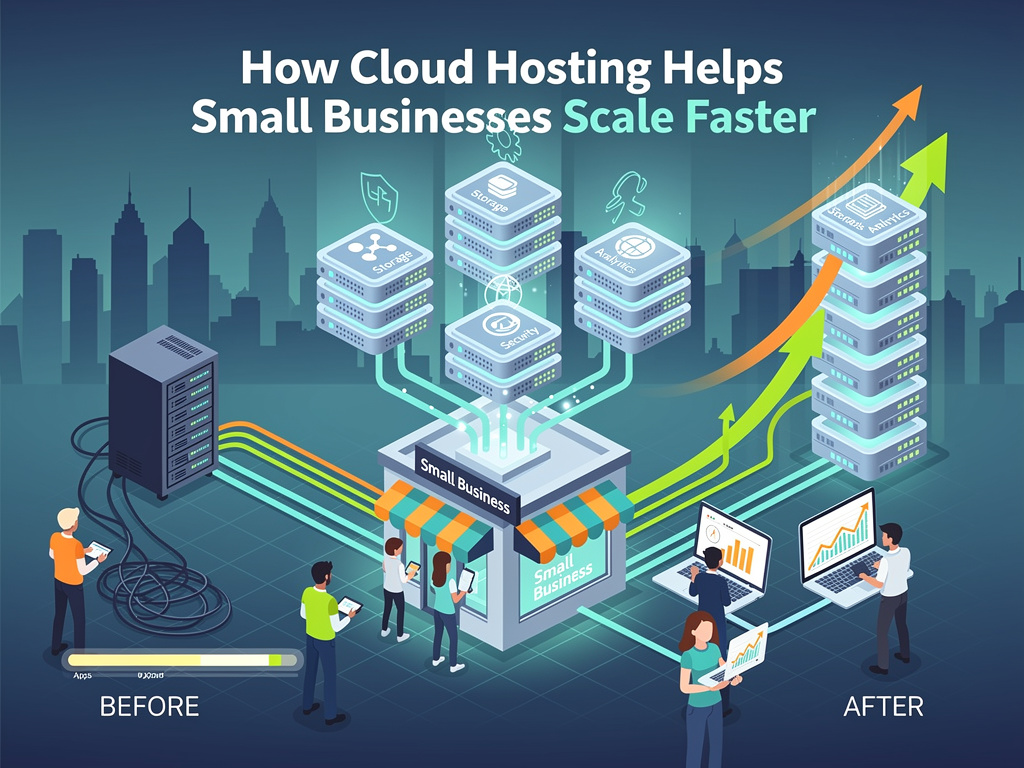
Most small businesses hit a wall at some point. Orders pick up, traffic spikes, the team grows—and suddenly the technology holding everything together starts creaking. The website slows down. The server crashes during peak hours. Customers leave, and revenue follows them out the door.
The good news is that this is a solvable problem, and more small businesses are finding the answer in cloud hosting. It is not just a technology upgrade. It is a strategic decision that directly affects how fast and how confidently your business can grow.
This article breaks down exactly how cloud hosting enables small businesses to scale faster and what to look for when making the switch.
What Cloud Hosting Actually Means for a Small Business
Traditional hosting puts your website on a single physical server. If that server runs out of resources or experiences a hardware failure, your website goes down. Cloud hosting, on the other hand, runs your website across a network of interconnected servers. Resources are pooled and distributed, which means your business is not dependent on any single point of failure.
For a small business owner, this translates to a website that stays online, loads quickly, and handles sudden bursts of traffic without breaking a sweat.
1. You Only Pay for What You Use
One of the most common complaints from small business owners about traditional hosting is cost predictability—or the lack of it. You either pay for a server that is bigger than you need, or you underbuy and get throttled at the worst possible moment.
Cloud hosting works on a flexible pricing model. Resources scale up when your traffic grows and scale back down when things quiet down. For seasonal businesses, product launches, or campaigns that drive unpredictable spikes in traffic, this flexibility is not just convenient. It is financially smart.
2. Your Website Stays Fast Under Pressure
A slow website costs you customers. Studies consistently show that even a one-second delay in page load time can significantly reduce conversions. When traffic surges — whether from a viral post, a sale, or a marketing campaign — a traditional server often buckles under the pressure.
Cloud hosting distributes the load across multiple servers, which means your website maintains its speed and performance even during traffic peaks. For small businesses competing against larger players, this performance advantage matters enormously.
3. Downtime Is No Longer a Constant Fear
Every hour your website is down is revenue you are not collecting. With traditional hosting, hardware failures, software updates, or maintenance windows can take your site offline unexpectedly. Cloud infrastructure is designed with redundancy built in. If one server has a problem, another takes over automatically.
This kind of high availability used to be reserved for enterprise-level businesses with enterprise-level budgets. Cloud hosting puts that reliability within reach for small businesses too.
4. Scaling Happens in Minutes, Not Months
Previously, if your business outgrew its hosting plan, you had the painful process of migrating to a bigger server, dealing with downtime, and hoping nothing broke. Cloud hosting removes that friction entirely.
Need more storage because your product catalog doubled? Need more processing power because you launched a new app? Cloud hosting allows you to scale resources up or down almost instantly, without downtime, without migrations, and without having to call in a specialist.
5. Better Security Without the IT Department
Small businesses are increasingly targeted by cybercriminals precisely because they often lack the security infrastructure of larger organizations. Cloud hosting providers invest heavily in security at the infrastructure level — firewalls, intrusion detection, DDoS protection, and automated backups are typically built into the service.
This means your business gets enterprise-grade protection without needing to hire a dedicated IT security team. That is a significant operational advantage for lean teams.
6. Your Data Is Backed Up Automatically
Data loss can be catastrophic for a small business. Whether it is customer records, transaction history, or your entire website, losing that data can take weeks to recover from — if recovery is even possible.
Most quality cloud hosting providers include automated daily backups as part of their service. You can restore your site to a previous state quickly and without technical expertise. It is a level of protection that small businesses often overlook until they need it.
7. Remote Teams Can Work Without Interruption
The shift to remote and hybrid work has made reliable cloud infrastructure even more important. When your website, business email, CRM, and applications all live in the cloud, your team can collaborate and serve customers from anywhere in the world without performance issues.
For small businesses with distributed teams or those serving customers across multiple time zones, this kind of always-on availability is not optional. It is essential.
What to Look for When Choosing Cloud Hosting for Your Small Business
Not all cloud hosting providers are created equal. Before you commit, here are the key things to evaluate:
- Uptime guarantee: Look for providers offering 99.9% or higher uptime SLAs
- Support quality: 24/7 support from real experts, not just chatbots, matters more than most business owners realize until something goes wrong
- Scalability: Can you upgrade your plan easily as your business grows?
- Security features: Automated backups, SSL certificates, firewalls, and DDoS protection should come standard
- Transparent pricing: Make sure there are no hidden fees for bandwidth overages or support requests
- Infrastructure: Cloud hosting powered by enterprise platforms like AWS or Microsoft Azure offers proven reliability
Your Next Step Forward
Cloud hosting is not a luxury for businesses that have already made it. It is a foundation that helps small businesses get there faster. Lower costs, greater reliability, seamless scalability, and enterprise-grade security — these are no longer privileges of large corporations.
If your business is still running on shared or traditional hosting, every day you wait is a day your growth is unnecessarily constrained.
With proven results, industry expertise, and reliable support, we consistently deliver outcomes that competitors cannot match. If you want an infrastructure that grows with your ambitions and never lets your visitors down, get in touch with Site2Host today.
📞 +91-88988 16336 | +91-97681 14582
📧 [email protected]🌍 www.site2host.com
Facebook
Twitter
LinkedIn
Email
Latest Post

September 17, 2026

September 10, 2026
August 29, 2026

Related Article
September 25, 2026
No Comments
September 25, 2026
No Comments
September 17, 2026
No Comments