


Is Your Business Email Safe? What You Need to Know About Email Security
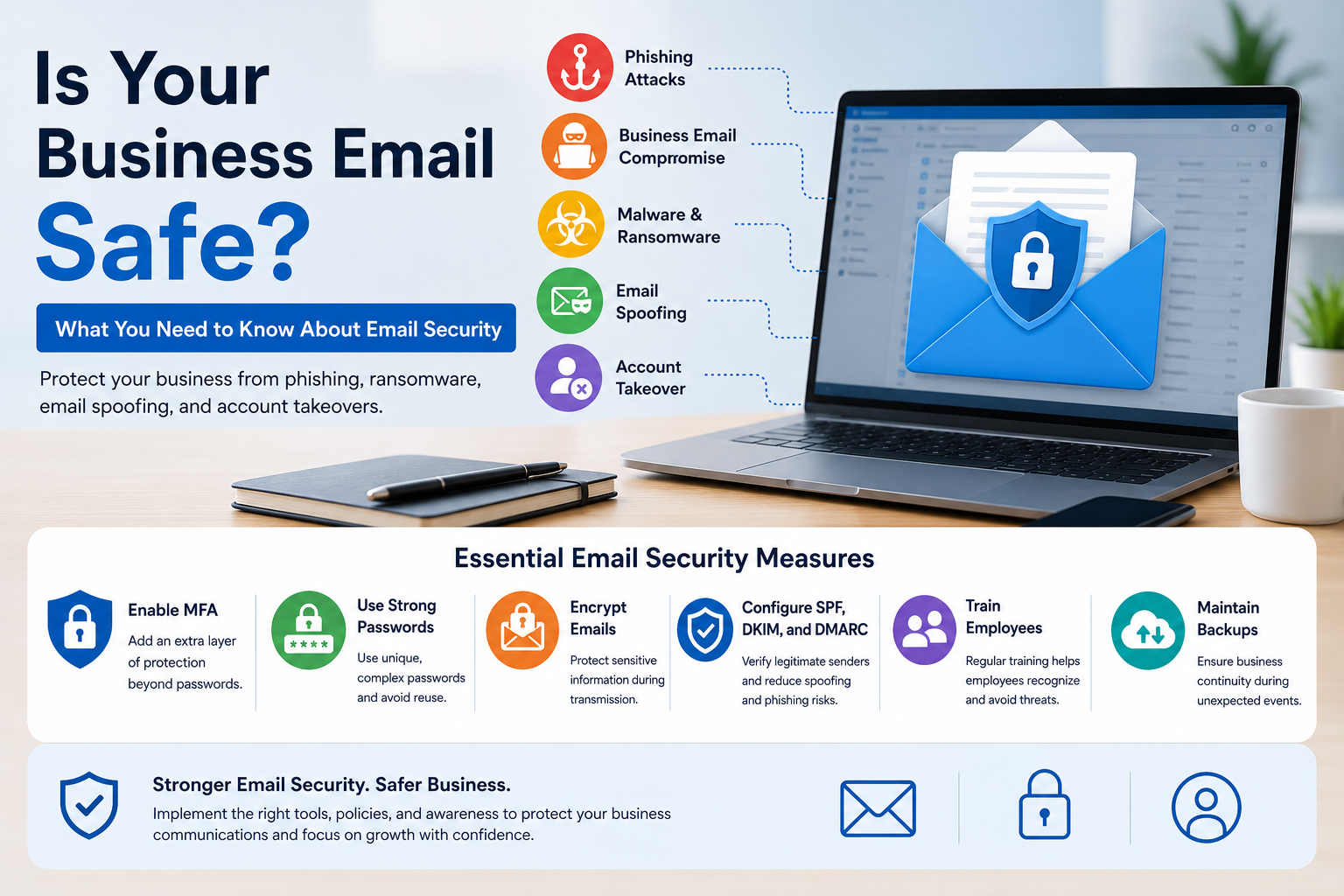
Email remains the backbone of business communication. Whether you’re sharing contracts, customer information, invoices, or internal updates, email is often the primary way organizations exchange critical information every day.
Unfortunately, cybercriminals know this too.
Businesses of all sizes are increasingly becoming targets of phishing scams, ransomware attacks, email spoofing, and account takeovers. A single compromised email account can lead to financial losses, data breaches, damaged customer trust, and operational disruptions.
The good news is that many email security risks can be prevented with the right tools, policies, and awareness. Understanding the basics of business email security is the first step toward protecting your company from costly cyber threats.
Why Business Email Security Matters
Business emails often contain sensitive information, such as
- Customer records
- Financial documents
- Contracts and proposals
- Employee information
- Login credentials
- Internal communications
If attackers gain access to these communications, the consequences can be severe. Beyond financial losses, businesses may face legal liabilities, compliance issues, and reputational damage that can take years to repair.
Email security is no longer optional. It is a critical part of any modern business security strategy.
Common Email Security Threats Businesses Face
Phishing Attacks
Phishing is one of the most common cyber threats today. Attackers send emails that appear to come from trusted organizations, encouraging recipients to click malicious links or share confidential information.
These emails often mimic:
- Banks
- Payment providers
- Business partners
- Government agencies
- Internal company departments
A single successful phishing attack can compromise multiple business systems.
Business Email Compromise (BEC)
Business Email Compromise occurs when attackers impersonate executives, vendors, or trusted contacts to trick employees into transferring money or sharing sensitive information.
These attacks are highly targeted and can result in significant financial losses.
Malware and Ransomware
Cybercriminals often distribute malware through email attachments or infected links. Once opened, malicious software can:
- Encrypt company files
- Steal sensitive data
- Disrupt operations
- Demand ransom payments
Email Spoofing
Email spoofing involves forging the sender’s address to make messages appear legitimate.
Without proper email authentication protocols, attackers can impersonate your domain and damage your organization’s credibility.
Account Takeover Attacks
Weak passwords, credential leaks, and poor security practices can allow attackers to gain direct access to business email accounts.
Once inside, they can monitor conversations, steal information, and launch additional attacks.
Warning Signs Your Email Security May Be at Risk
Many businesses don’t realize they have vulnerabilities until an incident occurs.
Watch for these warning signs:
- Employees receive frequent suspicious emails
- No multi-factor authentication is enabled
- Password policies are weak
- Email accounts are shared among multiple users
- Security updates are rarely performed
- No email backup strategy exists
- Domain authentication records are missing
Identifying these issues early can significantly reduce your risk.
Essential Email Security Measures Every Business Should Implement
Use Multi-Factor Authentication (MFA)
Multi-factor authentication adds an additional layer of protection beyond passwords.
Even if credentials are compromised, attackers will have difficulty accessing accounts without the second verification factor.
Implement Strong Password Policies
Encourage employees to:
- Use unique passwords
- Create complex passphrases
- Avoid password reuse
- Change compromised passwords immediately
Password managers can simplify secure password management across the organization.
Enable Email Encryption
Email encryption helps protect sensitive information during transmission.
This ensures that even if messages are intercepted, unauthorized parties cannot easily read the contents.
Configure SPF, DKIM, and DMARC
These email authentication technologies help verify legitimate email senders and reduce domain spoofing risks.
Benefits include:
- Improved email deliverability
- Reduced phishing attempts
- Enhanced domain reputation
- Better protection for customers and employees
Train Employees Regularly
Technology alone cannot stop every attack.
Employee awareness training should cover:
- Phishing identification
- Suspicious attachments
- Safe link handling
- Password security
- Reporting procedures
Well-trained employees often become the strongest defense against cyber threats.
Maintain Regular Backups
A reliable email backup solution protects against:
- Accidental deletion
- Ransomware attacks
- System failures
- Data corruption
Regular backups ensure business continuity during unexpected incidents.
Choosing the Right Business Email Platform
Not all email solutions provide the same level of security.
Modern business email platforms typically include:
Google Workspace
Offers:
- Advanced spam filtering
- Security monitoring
- MFA support
- Secure collaboration tools
Microsoft 365
Provides:
- Enterprise-grade security controls
- Threat protection tools
- Data loss prevention features
- Compliance management
Titan Business Email
An affordable option that includes:
- Professional email hosting
- Anti-spam protection
- Secure business communication tools
- User-friendly management features
Selecting the right platform depends on your organization’s size, security requirements, and budget.
How Professional Email Security Protects Your Business Growth
Strong email security delivers more than protection.
It also helps businesses:
- Build customer trust
- Improve communication reliability
- Protect brand reputation
- Maintain regulatory compliance
- Reduce downtime
- Avoid costly security incidents
As organizations become more dependent on digital communication, secure email infrastructure becomes a competitive advantage.
Why Businesses Are Moving to Managed Email Solutions
Many small and medium-sized businesses lack dedicated IT security teams.
Managed email solutions provide:
- Expert security management
- Threat monitoring
- Secure migrations
- Ongoing support
- Advanced protection technologies
This allows businesses to focus on growth while experts manage email security behind the scenes.
Your Next Step Forward
Email threats continue to evolve, but the right security strategy can dramatically reduce your risk. By implementing strong authentication, employee training, email encryption, authentication protocols, and reliable backup systems, businesses can protect their most valuable communications.
At Site2Host, we help businesses secure their email infrastructure with professional solutions, including Google Workspace, Microsoft 365, Titan Email, email migration services, advanced security configurations, and expert support. With 25+ years of industry experience, 24/7 technical assistance, and a commitment to reliable business communication, we provide the protection modern organizations need.
If you’re ready to strengthen your business email security and ensure your communications remain protected, contact Site2Host today and discover a safer, more reliable email solution for your organization.
With proven results, industry expertise, and reliable support, we consistently deliver outcomes that competitors cannot match. If you want an infrastructure that grows with your ambitions and never lets your visitors down, get in touch with Site2Host today.
📞 +91-88988 16336 | +91-97681 14582
📧 [email protected]🌍 www.site2host.com
Facebook
Twitter
LinkedIn
Email
Latest Post

September 17, 2026

September 10, 2026
August 29, 2026

Related Article
September 25, 2026
No Comments
September 25, 2026
No Comments
September 17, 2026
No Comments