


Why Every Business Website Needs an SSL Certificate in 2026
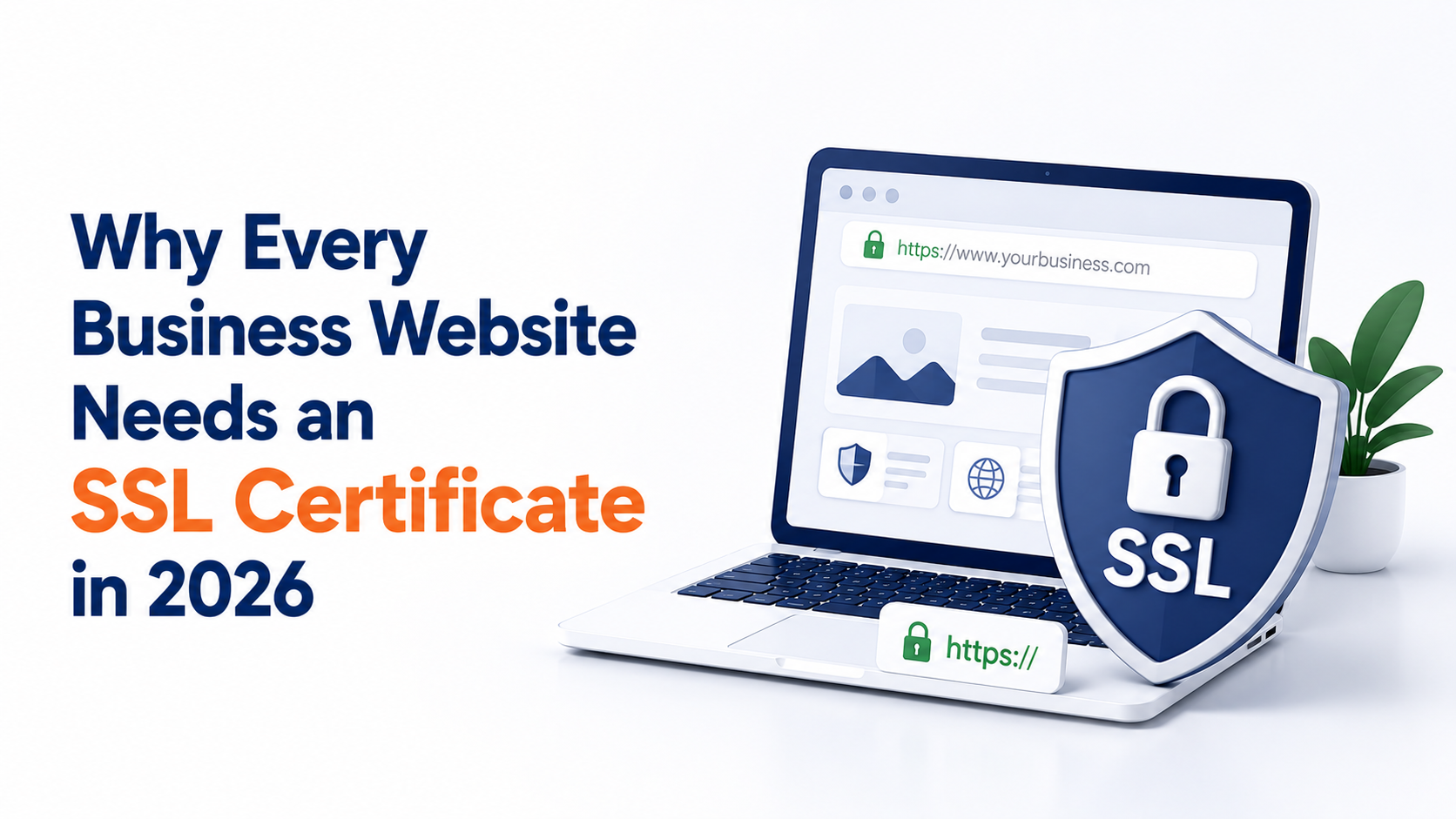
Imagine a potential customer finds your website through Google, visits your contact or checkout page, and sees a browser warning that the connection is not secure. Would they continue?
Probably not.
In 2026, customers expect businesses to provide a secure online experience. Whether you run a small business website, an e-commerce store, a professional portfolio, or a corporate website, website security directly affects how people perceive your brand.
This is where an SSL certificate becomes essential.
SSL, which stands for Secure Sockets Layer, encrypts the connection between a visitor’s browser and your website. Once SSL is properly installed, your website uses HTTPS instead of HTTP and displays the familiar padlock or secure connection indicator in modern browsers.
But SSL is about more than a padlock. It helps protect sensitive information, strengthens customer confidence, supports secure transactions, and forms an important part of a modern website security strategy.
What Is an SSL Certificate?
An SSL certificate is a digital certificate that helps establish a secure, encrypted connection between a website and its visitors.
When someone enters information such as:
- Name and contact details
- Login credentials
- Payment information
- Enquiry forms
- Account information
SSL helps encrypt the data while it travels between the user’s browser and the website server.
For example, a website using:
is different from:
The “S” in HTTPS indicates that the connection is protected using encryption.
For businesses, this provides an important layer of protection and helps visitors feel more confident when interacting with the website.
Why Is SSL Important for Business Websites in 2026?
Cybersecurity threats continue to evolve, while customers are becoming more conscious about how their information is handled.
An SSL certificate helps businesses address several important areas.
1. Protects Customer and Business Data
Every day, websites collect valuable information through contact forms, registrations, logins, online purchases, and other interactions.
Without proper encryption, data transmitted between a visitor and a website can be more vulnerable to interception.
SSL encrypts this communication, helping protect information while it is being transmitted.
For an e-commerce business, for example, protecting customer information should be a basic requirement rather than an optional feature.
2. Builds Customer Trust
Trust is one of the most important factors in online decision-making.
Before purchasing a product, submitting an enquiry, or creating an account, visitors want to know that the website is safe.
HTTPS provides a visible signal that the website has taken steps to secure its connection.
This is particularly important for:
- E-commerce websites
- Financial and professional services
- Healthcare-related businesses
- SaaS platforms
- Membership websites
- Business websites collecting enquiries
A secure website creates a more professional first impression.
3. Helps Prevent Browser Security Warnings
Modern browsers actively identify websites that do not use secure connections.
Depending on the browser, page type, and user action, visitors may see security-related warnings or indicators when interacting with an unsecured website.
A warning can immediately create doubt.
Even if your business website does not process online payments, a visitor may still hesitate to submit a form or share personal information if the browser indicates that the connection is not secure.
4. Supports Secure Online Transactions
If your website sells products or services online, security becomes even more important.
Customers expect checkout pages, login areas, payment-related processes, and other sensitive interactions to be protected.
An SSL certificate helps secure communication between the browser and your website.
However, it is important to understand that SSL alone does not make an entire website or payment system completely secure. Businesses should combine SSL with secure hosting, software updates, strong passwords, malware protection, backups, and other security measures.
5. Supports Your SEO Strategy
Website security is also relevant to SEO.
Google has encouraged websites to move toward HTTPS, and HTTPS is a lightweight ranking signal. While installing SSL will not suddenly move a website from page 50 to page 1, having HTTPS is an important part of maintaining a technically sound website.
SEO is built from many signals, including:
- Technical performance
- Content quality
- Search intent
- Website experience
- Mobile usability
- Website security
- Authority and backlinks
SSL should therefore be treated as part of your overall technical SEO foundation rather than as a standalone ranking shortcut.
6. Protects Your Brand Reputation
A security incident can damage more than a website.
It can affect customer confidence, brand reputation, sales, and long-term relationships.
For a growing business, reputation is an asset.
Using HTTPS demonstrates that website security is being taken seriously and gives customers greater confidence when interacting with your online presence.
What Happens If Your Website Doesn’t Have SSL?
Running a business website without SSL can create several problems.
Visitors may encounter security warnings, particularly when entering information on unsecured pages. Search engines and browsers also increasingly expect websites to use HTTPS.
Potential consequences include:
- Reduced customer trust
- Lower confidence during enquiries
- Security risks for transmitted information
- Poorer user experience
- Complications with secure website features
- A less professional online presence
- Technical and SEO issues during migration or implementation
For a business that depends on its website for leads or sales, these risks are difficult to justify when SSL is widely available.
How to Choose the Right SSL Certificate
Not every website needs the same type of SSL certificate.
The right option depends on your website structure, number of domains, business requirements, and level of validation required.
Common options include:
Single-Domain SSL
Designed to secure one domain.
This can be suitable for a straightforward business website such as:
www.yourbusiness.com
Wildcard SSL
A wildcard certificate can secure a main domain and its subdomains.
For example:
yourbusiness.com
and:
blog.yourbusiness.com
shop.yourbusiness.com
This can be useful for businesses operating multiple subdomains.
Multi-Domain SSL
Multi-domain certificates can secure multiple domains under one certificate, depending on the certificate configuration.
This can be useful for organizations managing several related domains.
Organization Validation SSL
Organization Validation certificates involve additional business verification and can be appropriate for organizations that want stronger identity assurance than basic domain validation.
The best choice depends on your specific website architecture and security requirements.
7 Things to Check Before Installing SSL
Installing an SSL certificate is only one part of the process. A proper implementation matters.
1. Choose a Reliable SSL Provider
Select an SSL certificate that fits your website and business requirements.
Avoid choosing purely on price. Consider certificate support, compatibility, renewal, and technical assistance.
2. Install the Certificate Correctly
The certificate needs to be correctly installed on your hosting environment.
A configuration problem can result in certificate errors or an insecure connection.
3. Redirect HTTP to HTTPS
After installation, ensure the HTTP version redirects properly to the HTTPS version.
For example:
http://yourwebsite.com
should redirect to:
https://yourwebsite.com
This also helps search engines understand the preferred version of your website.
4. Update Internal Links
Check your website’s internal links, images, scripts, CSS files, and other resources.
Mixed-content issues can occur when an HTTPS page still loads certain resources through HTTP.
5. Update Canonical URLs
Make sure canonical tags point to the HTTPS version of your pages.
This is especially important when migrating an established website from HTTP to HTTPS.
6. Update Search Engine Tools
After an HTTPS migration, review your Google Search Console properties, sitemap configuration, analytics setup, and other SEO tools.
Make sure the secure version is properly tracked and monitored.
7. Keep Your Certificate Active
An expired SSL certificate can cause browser warnings and disrupt customer trust.
Set up renewal reminders or use a hosting provider that can help manage certificate renewals.
SSL Is Only One Part of Website Security
One common misconception is that an SSL certificate makes a website completely secure.
It doesn’t.
SSL protects data while it travels between a browser and server, but businesses need a broader security strategy.
A reliable website security setup can include:
SSL + Secure Hosting + DDoS Protection + Regular Backups + Malware Protection + Software Updates + Strong Access Controls
For example, if a WordPress website has an SSL certificate but uses outdated plugins and weak administrator passwords, it can still be vulnerable.
This is why website security should be approached as an ongoing process rather than a one-time installation.
How SSL Works With Secure Web Hosting
Your SSL certificate and web hosting work together.
The hosting server needs to support the certificate correctly and provide a secure environment for your website.
This is why choosing a reliable hosting provider matters.
For businesses, a good hosting environment should ideally combine:
- Secure server infrastructure
- SSL support
- Reliable uptime
- Regular backups
- DDoS protection
- Performance optimization
- Technical support
- Scalable hosting options
Site2Host provides web hosting and cloud infrastructure solutions designed to help businesses manage these requirements from one platform. Its hosting services include NVMe-powered web hosting, VPS solutions, AWS and Azure hosting, SSL certificates, Acronis backup solutions, and migration assistance.
SSL for Different Types of Businesses
Small Businesses
A local business website may collect enquiries, phone numbers, email addresses, and customer information.
SSL helps provide a safer browsing experience and builds credibility.
E-commerce Businesses
For online stores, website security is critical.
Customers need confidence when creating accounts, submitting information, and completing purchases.
SSL should be considered a fundamental requirement for an e-commerce website.
Corporate Websites
Corporate websites represent an organization online.
Using HTTPS helps maintain a professional and trustworthy digital presence while protecting website communication.
Freelancers and Developers
Freelancers and developers often manage websites for multiple clients.
Having a reliable SSL solution makes it easier to provide clients with a secure website infrastructure.
SaaS and Web Applications
Applications involving logins, dashboards, user accounts, or sensitive information require secure communication.
SSL is an essential part of that environment.
A Simple SSL Checklist for 2026
Before considering your website security setup complete, check:
- Is the website accessible through HTTPS?
- Does HTTP automatically redirect to HTTPS?
- Is the SSL certificate valid and not expired?
- Are there mixed-content warnings?
- Do canonical URLs use HTTPS?
- Are internal links updated?
- Is the HTTPS version configured correctly in SEO tools?
- Are website backups active?
- Is your hosting environment secure?
- Are WordPress, plugins, themes, and other applications updated?
If you answer “no” to any of these questions, your website may need further technical attention.
Why Businesses Shouldn’t Treat SSL as an Optional Upgrade
Ten years ago, some businesses viewed SSL as something mainly required for online stores and payment pages.
That approach no longer makes sense.
Modern websites frequently collect information through forms, login systems, analytics, marketing tools, customer portals, and other technologies.
More importantly, customers have become accustomed to secure websites.
An SSL certificate is therefore not simply a technical add-on. It is part of the basic infrastructure of a credible online business.
Your Next Step Forward
A secure website helps protect customer information, strengthen trust, support your technical SEO foundation, and create a more professional online experience.
But SSL works best when it is combined with reliable hosting, backups, DDoS protection, regular maintenance, and expert technical support.
Site2Host brings these essential services together under one platform, helping businesses avoid the complexity of managing multiple providers. With 25+ years of experience, NVMe-powered hosting, 99.9% uptime commitment, enterprise-grade security, free website migration, and 24/7 expert support, Site2Host provides a practical foundation for businesses that want reliable and secure hosting.
If you’re launching a new website, migrating an existing site, or looking to strengthen your current hosting environment, choose Site2Host for secure, reliable, and affordable web hosting and cloud solutions.
With proven results, industry expertise, and reliable support, we consistently deliver outcomes that competitors cannot match. If you want an infrastructure that grows with your ambitions and never lets your visitors down, get in touch with Site2Host today.
📞 +91-88988 16336 | +91-97681 14582
📧 [email protected]🌍 www.site2host.com
Facebook
Twitter
LinkedIn
Email
Latest Post

September 17, 2026

September 10, 2026
August 29, 2026

Related Article
September 25, 2026
No Comments
September 25, 2026
No Comments
September 17, 2026
No Comments